
An iPhone 13 with 85% battery health often outlasts an older iPhone 8 at 100% capacity. It sounds counterintuitive, but processor efficiency matters just as much as the percentage on your screen. Most South African buyers feel a spike of anxiety when they see anything less than a perfect score. You want to ensure your pre-owned iPhone battery health is high enough to survive a full work day without hunting for a power bank or facing an immediate R2,000 replacement bill.
We understand the stress. You don’t want to get stuck with hidden defects or a device that slows down because it hit the critical 80% threshold. You deserve to know exactly what you are paying for before you tap buy. This 2026 guide simplifies the technical jargon like peak performance capability so you can shop with total confidence. We will break down your rights under the Consumer Protection Act and explain how to find a device that handles the latest iOS 26.5.1 updates with ease. Learn how to spot a winner and secure a device that lasts.
Key Takeaways
- Understand why pre-owned iPhone battery health is a measure of long-term capacity, not just your daily charge level.
- Discover why the 85% to 94% “Sweet Spot” offers the best balance of high-end performance and significant savings.
- Learn the exact steps to verify a device’s condition, including how to spot “Important Battery Messages” that signal non-genuine parts.
- Master local maintenance tips to protect your battery from South African summer heat and erratic load shedding schedules.
- Find out how our rigorous testing and 80% minimum health guarantee take the risk out of your next purchase.
What Exactly Is Pre-Owned iPhone Battery Health?
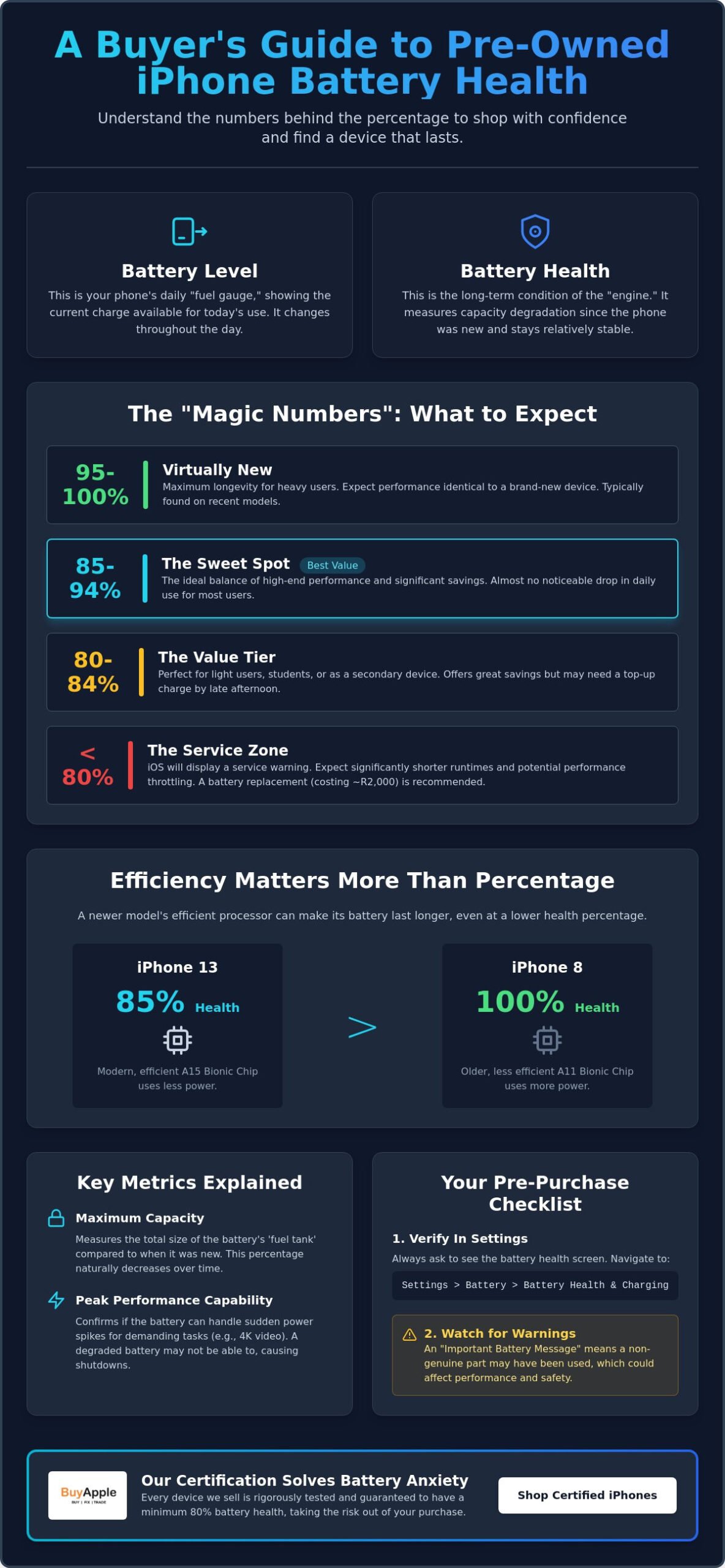
Think of your iPhone battery like a car engine. Your Battery Level is the fuel gauge, showing how much petrol you have for the day. Battery Health is the actual condition of the engine. It tells you how much the battery has worn down since it left the factory. When you shop for a used device, understanding pre-owned iPhone battery health is the difference between a phone that lasts all day and one that dies during your afternoon commute.
Every iPhone uses lithium-ion technology because it charges faster and lasts longer than older battery types. To get into the technical details, you can read more about how lithium-ion batteries work. These batteries are consumable components. They don’t just wear out from use; they age chemically. Finding a device with 100% health in the pre-owned market is rare. If you see a 100% rating on an older iPhone 11 or iPhone 12, it usually means the battery was recently replaced. For most buyers, a “normal” and healthy range for a used device sits between 85% and 95%.
Apple makes this easy to track. Inside your settings, iOS monitors these metrics in real time. It gives you a transparent look at the battery’s condition so there are no surprises. This system ensures you know exactly what you are buying before you commit your hard-earned money.
Maximum Capacity vs. Peak Performance Capability
Maximum Capacity measures the total size of your “fuel tank”. A brand new iPhone 14 starts at 100%. As the battery ages, that tank shrinks. If your capacity is 88%, your phone can only hold 88% of the charge it did when it was new. It’s a simple way to see how much life is left in the hardware.
Peak Performance Capability is just as vital. This metric tracks if the battery can handle sudden power spikes. Intense tasks like gaming or filming 4K video require a lot of energy quickly. If a battery is too weak to provide that surge, the phone might shut down unexpectedly. iOS manages this by balancing performance with battery health to keep your device stable and reliable.
The ‘Chemical Age’ Factor
Chemical aging is the gradual loss of a battery’s ability to hold a charge over time. It is a natural process, but it doesn’t happen at the same speed for every phone. A two-year-old iPhone 13 with 90% health is often a better purchase than a four-year-old iPhone XR with the same percentage. The older battery has been through more internal chemical stress, even if the percentage looks high.
Several factors accelerate this aging process. High heat is the biggest enemy of pre-owned iPhone battery health. Constant exposure to the South African sun or leaving your phone in a hot car can cause permanent damage. Frequent charging cycles also play a role. Every time you charge from 0% to 100%, you complete a cycle. The more cycles a battery has, the more its internal chemistry breaks down. Choosing a newer model usually means you are getting a battery with fewer cycles and a fresher chemical profile. If you are weighing up a certified pre-owned iPhone vs new South Africa purchase, understanding this chemical age factor is essential to making the right call.
The Magic Numbers: Is 80% Battery Health Good Enough?
Numbers tell a story. When you look at pre-owned iPhone battery health, the percentage on the screen helps you predict how many hours of WhatsApp, TikTok, and work calls you will get. Apple defines a healthy battery as anything above 80%. But for most South African buyers, “good enough” depends on your daily routine and your budget. Choosing the right tier ensures you don’t overspend on capacity you might not need.
- 95% to 100%: This is virtually new. You will mostly find these numbers on recent models like the iPhone 14 or iPhone 15. It offers maximum longevity for heavy users.
- 85% to 94%: This is the Sweet Spot. You get significant savings on the price tag with almost no noticeable drop in daily performance.
- 80% to 84%: The Value Tier. These devices are perfect for light users or students on a strict budget who stay near a charger during the day.
- Below 80%: The Service Zone. At this point, iOS may warn you that the battery is degraded. Expect shorter runtimes and potential performance issues.
Why do these numbers drop? Recent battery degradation research shows that physical changes at an atomic level eventually limit how much energy a cell can hold. This is why we ensure every device we sell meets a high standard. You can browse our certified stock to find a device that still has plenty of life left.
Real-World Usage: Hours vs. Percentages
Don’t just look at the percentage. The model matters too. An iPhone 13 with 85% health will likely outlast an iPhone 11 with 85% health. Newer models use the A15 or A16 Bionic chips. These processors are much more efficient at managing power. They do more work while sipping less energy. If you buy a newer model, a slightly lower battery percentage isn’t a dealbreaker. Use features like Optimised Battery Charging in iOS to slow down future wear. It learns your routine and waits to finish charging past 80% until you need it. This protects your pre-owned iPhone battery health for the long run.
Performance Throttling and Lag
A weak battery does more than just run out of juice. It can actually slow your phone down. When iOS detects that a battery can no longer support peak power, it applies performance management. This prevents the phone from shutting down during heavy tasks. You might notice apps taking longer to launch or a lower frame rate while scrolling. Check this in your settings under Battery Health & Charging. If it says your battery is supporting normal peak performance, your speed is safe. If not, it is time for a fresh device.
How to Verify Battery Health Before You Buy
Buying from a private seller on Facebook Marketplace or Gumtree requires a different level of caution than buying from a retail shop. You need proof. Don’t just trust a text description that says “battery is perfect.” You must see the data for yourself. Follow these four steps to secure your investment and ensure the pre-owned iPhone battery health is exactly what the seller claims.
- Step 1: Request a real-time screenshot of the Battery Health & Charging screen. This is located in Settings > Battery. If you aren’t sure where to look, this guide on How to check iPhone battery health walks you through the menus step-by-step.
- Step 2: Check for an “Important Battery Message.” If a battery was replaced by an unauthorized technician, iOS will display a warning. This means the phone cannot verify the part is genuine.
- Step 3: Ask for the cycle count. If you are buying an iPhone 15 or newer, you can find this in Settings > General > About. A low cycle count usually means the battery has more life left than a high one, even if the percentages are similar.
- Step 4: Confirm the return policy. Under the Consumer Protection Act in South Africa, you have rights if a product is defective. Ensure the seller or shop provides a written guarantee for at least six months. Our complete guide on what to check when buying a pre-owned iPhone covers every verification step in detail, from IMEI blacklist checks to iCloud lock status.
Remote Verification for Online Shoppers
Are you buying from a seller in another province? Video proof is superior to a static screenshot. Ask the seller to record a quick video of them navigating from the home screen into the battery settings. Static images are easy to edit or “borrow” from other listings. Be wary of “boosted” batteries. If a five-year-old iPhone 11 claims 100% health, it is likely a cheap replacement or a manipulated reading. Real batteries age. If the number looks too good to be true, it probably is.
The Importance of Genuine Parts
Cheap, third-party batteries are common in the pre-owned market. These parts often lack the internal chips required for the phone to communicate with the software. This can lead to overheating or sudden shutdowns. When you choose Certified Pre-Owned Apple Devices South Africa: The 2026 Guide, you ensure that every component has been tested by professionals. We verify that the pre-owned iPhone battery health meets our strict standards so you don’t have to worry about non-genuine warnings or safety risks. Stick to sellers who offer transparency and a clear technical audit of their stock.
Maintaining iPhone Battery Health in the South African Climate
Your environment dictates how long your phone lasts. In South Africa, our extreme weather and erratic power supply create a “perfect storm” for hardware. If you want to protect your pre-owned iPhone battery health, you must adapt your habits to local conditions. A few simple changes can add months or even years to your device’s lifespan. It is about being proactive rather than waiting for a warning message to appear.
Heat: The Silent Battery Killer
Summer in Jo’burg or Durban is brutal for electronics. High temperatures cause internal chemical reactions to speed up, which wears out the battery faster. Never leave your iPhone on a car dashboard or in direct sunlight. This is catastrophic for the hardware. Lithium-ion batteries degrade 20% faster when consistently exposed to temperatures above 35°C. If your phone feels hot to the touch, remove the case immediately. Place it in a cool, shaded area. Avoid the temptation to put it in a fridge; the sudden moisture can cause internal damage. Keep it within the ideal range of 16°C to 22°C whenever possible.
Charging Habits During Load Shedding
Power cuts are more than just an inconvenience. They disrupt your charging rhythm and can accelerate chemical aging. Many users wait until their phone is at 1% to charge it before the lights go out. This is a mistake. Deep discharges put immense stress on the battery cells. Aim for the “20-80 Rule.” Try to keep your battery between 20% and 80% capacity. This range is the least stressful for lithium-ion chemistry. Use a high-quality power bank to maintain a steady voltage during outages. Cheap power banks often have “dirty” power delivery that can spike and damage your charging port or the battery itself.
Quality accessories are non-negotiable. Those cheap cables from mall kiosks might save you money today, but they cost you more tomorrow. Original or MFi-certified cables ensure your phone receives the exact voltage it needs. Uncertified chargers often lack surge protection, which is vital when the power returns after load shedding. Protect your investment by using the right gear from the start. If you are looking for a device that has been properly cared for, shop our range of tested iPhones today. We verify every unit to ensure it arrived from a background of good charging habits and careful use. Stay above that 80% threshold longer by being proactive with your care.
Why BuyApple’s Certification Solves the Battery Anxiety
Anxiety is the biggest hurdle when buying a used device. You wonder if the previous owner treated it well. You worry the battery might fail the moment the courier leaves. We built our certification process to eliminate these doubts. Our focus on pre-owned iPhone battery health ensures you don’t get stuck with a “dud” that needs a replacement in a month. We take the risk so you don’t have to.
We maintain a strict 80% minimum capacity for every device. If a phone doesn’t hit that mark, it doesn’t make it to our store. But we go deeper than just reading a percentage in the settings menu. A high percentage can hide a faulty cell that drops voltage under load. Our technicians use specialized diagnostic tools to stress-test every unit. We check how the battery handles high-demand tasks and ensure it remains stable. You get a phone that doesn’t just look good on paper; it performs in the real world.
- Strict 80%+ Minimum: No exceptions for any certified pre-owned device.
- Voltage Stress Testing: We verify stability under heavy processing loads.
- Transparent Grading: Every listing clearly states the condition and battery health tier.
- Local Support: Our team is based in South Africa and ready to help.
The BuyApple CPO Guarantee
Peace of mind comes from knowing someone has your back. We only use genuine components during our refurbishment process. This maintains the hardware integrity and ensures iOS features like Peak Performance Capability work perfectly. If your battery shows a genuine defect or drops health unexpectedly shortly after purchase, our comprehensive South African warranty covers you. We prioritize your satisfaction over a quick sale. It’s about building long-term trust with every customer.
Value Comparison: BuyApple vs. Private Sellers
A private deal might look like a bargain at first. You might save R500 by buying from a stranger on social media. However, if that pre-owned iPhone battery health is actually degraded or “boosted,” you face a R1,500 repair bill almost immediately. You lose the saving and the convenience. Buying from a registered South African retailer gives you legal protection and a clear point of contact. If you are still looking for ways to save, check out our guide on Finding a Cheap iPhone in South Africa: The 2026 Value Guide. Choose the security of a certified device and enjoy your iPhone without the battery stress.
Secure Your Next iPhone with Total Battery Confidence
Finding a device with great pre-owned iPhone battery health doesn’t have to be a guessing game. You now have the tools to look past the surface and understand the real chemical age of your hardware. Remember that model efficiency is just as vital as the percentage on your screen. Always verify the health through settings or buy from a source that guarantees their testing process. Protecting your battery from the South African sun and managing your charging during load shedding will keep your device running smoothly for years.
Don’t settle for risky private sales or undisclosed defects. You deserve a phone that lasts through your longest work days without anxiety. Our technical team handles the hard work of testing and verification so you can shop with ease. Get the premium technology you want at a price that fits your budget. Before you decide, our detailed breakdown of a certified refurbished iPhone vs new South Africa purchase can help you determine which option delivers the best value for your specific needs.
Shop Guaranteed 80%+ Battery Health iPhones at BuyApple. Every device is Certified Pre-Owned and comes with a full warranty. Plus, enjoy free delivery across South Africa. Your perfect iPhone is waiting for you.
Frequently Asked Questions
Is 85% battery health good for a pre-owned iPhone 13?
Yes, 85% is considered very good for a device that is a few years old. Since the iPhone 13 uses the highly efficient A15 Bionic chip, this capacity still provides enough power for most users to get through a standard day. It represents a great balance between a discounted purchase price and reliable daily performance. You won’t notice significant lag or performance throttling at this level.
Will a pre-owned iPhone with 80% battery health last a whole day?
It depends on your usage, but 80% is the threshold where you might start needing a midday top-up. For light users who mostly check messages, it can last until the evening. However, if you use GPS or film video, you should carry a power bank. At this level, the pre-owned iPhone battery health is nearing the point where Apple officially recommends a service.
How much does it cost to replace an iPhone battery in South Africa?
Professional battery replacement costs generally range from R249 to R2,000 as of June 2026. The exact price depends on whether you visit an official Apple provider or a reputable third-party shop. Older models like the iPhone 8 are on the lower end of the scale. Newer models like the iPhone 14 or 15 require more expensive parts and specialized labor to maintain water resistance.
Can I trust the battery health percentage shown in the settings?
Yes, the built-in iOS reporting is generally accurate, but it can be manipulated by dishonest sellers using “boosting” software. This is why you should always look for the Important Battery Message in your settings. If the phone was repaired with non-genuine parts, iOS will display a warning. Buying from a certified retailer ensures the reading you see is the true state of the hardware.
Does fast charging ruin my pre-owned iPhone’s battery health?
Fast charging does not ruin your battery, but the heat generated during the process can accelerate wear over time. iPhones have internal safeguards to manage the current and prevent damage. To protect your pre-owned iPhone battery health, avoid using your phone for gaming or heavy tasks while it is fast charging. This prevents the device from getting too hot, which is the real enemy of longevity.
What is a ‘high cycle count’ for an iPhone battery?
Apple considers a battery to be high cycle once it passes 500 complete charge cycles for older models or 1,000 cycles for the iPhone 15 series. At this point, the battery is expected to retain roughly 80% of its original capacity. If you are buying a used device, a cycle count under 300 is usually considered excellent. Anything over 600 suggests a replacement may be needed soon.
Why is my pre-owned iPhone getting hot while charging?
Some heat is normal during charging, but excessive heat often points to using a non-genuine charger or a thick protective case. South African summer temperatures can also push the device past its comfort zone. If your phone feels painful to touch, unplug it and remove the case immediately. Using high-quality MFi-certified cables ensures the voltage stays stable and prevents the internal components from overheating.
Should I replace the battery as soon as it hits 79%?
You don’t have to replace it immediately, but you will notice a drop in performance and shorter runtimes. At 79%, iOS will officially label the battery as Degraded and may apply performance management to prevent unexpected shutdowns. If the phone still meets your daily needs and doesn’t lag, you can keep using it. However, a fresh battery will make an older device feel brand new again.